
Romans on the Moselle
Temple districts in Altbachtal (Trier)
Literature:
Faust, S. (2007) “Pagane Tempelbezirke und Kultbauten”, in Konstantin der Große - Imperator Caesar Flavius Constantinus, Philipp von Zabern, Mainz 2007 (p329).
Cüppers, H. (1990), “Tempelbezirk im Altbachtal”, in Heinz Cüppers (ed.): Die Römer in Rheinland-Pfalz, pp. 588-591.
Trier: Die Stadt der Römer / The Roman City - Lambert Dahm (2014); Verlag für Geschichte und Kultur
Useful web sites:
https://de.wikipedia.org/wiki/Tempelbezirk_im_Altbachtal
https://kulturdb.de/einobjekt.php?id=14718
https://www.kuladig.de/Objektansicht/O-94770-20140615-5
Google map link:
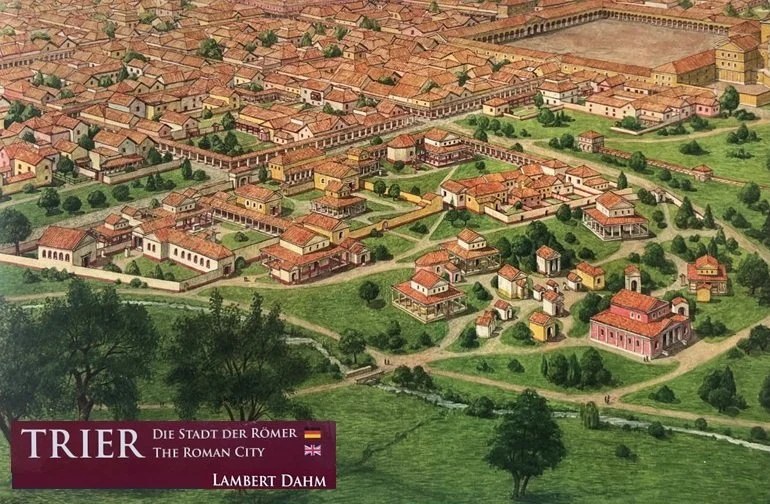
The temple district in Altbachtal was completely built over already in the early middle ages, and there is little visible trace of it above ground today.
In contrast with Trier’s larger Roman temples, the Altbach temple district, located on the South-Eastern edge of the city (but inside the city walls), consisted of a large number of moderately sized temples and smaller cult shrines. Covering an area of 5 hectares, the temple district was dedicated to a variety of Treveri-Roman deities and the district kept evolving over the centuries. It is one of the largest cult sites north of the Alps, as well as one of the most elaborate temple complexes found in the Treveri region.
In the 19th century, numerous figurines of gods, terracotta objects, and pottery shards were recovered in this extensive area. From 1926 to 1934, more in-depth excavations were carried out as part of a public employment scheme. These excavations led to the discovery of more than 70 temples, chapels, sacred precincts, a cult theater, and priests' houses, even though only around one-seventh of the whole area was excavated.
After the war, the site was filled and leveled with rubble from the destroyed city and, now covered with allotment gardens, is a protected archaeological site. Numerous temple cells and chapels were excavated only to the extent necessary to determine their ground plan. The soil therefore still contains remnants of the furnishings and traces of earlier structures.
Besides traces of pre-Roman settlement, the area was developed as a cult precinct already in the Augustan era. Wooden structures were replaced by substantial stone buildings in the second half of the first century CE. Unlike Trier’s other, more monumentalist temples, those at Altbachtal did not replicate the typical Greco-Roman temple design, but instead followed the uniquely Gallo-Roman ambulatory model. This did not exist in Rome, but had possibly evolved from celtic designs.
In the third-to-fourth century, the cult of Mithras was added to the hitherto exclusively local Treverian gods and cults.
Archaeological findings also suggest that the district suffered from some destruction by Christians in 337 CE during the time of Bishop Maximinus, yet some use seems to have continued also thereafter. More destruction took place towards the end of the fourth century, when two new streets were constructed through the temple district. Parts of the temple district were occupied by secular dwellings in the fourth century, with villas being built on the hillside. During the period of transition to Christianity, followers of the old gods may have continued to conduct sacrifices in secret here.