
Romans on the Moselle
Temple of Asclepius (Trier)
Literature:
Faust, S. (2008) “Moselufer: Römischer Tempel”, in Führer zu archäologischen Denkmälern des Trierer Landes; (p.52), Schriftenreihe des Rheinischen Landesmuseums Trier 35, Trier.
Faust, S. (2007) “Pagane Tempelbezirke und Kultbauten”, in Konstantin der Große - Imperator Caesar Flavius Constantinus, Philipp von Zabern, Mainz 2007 (p327).
Cüppers, H. (1990), “Tempel des Asclepius”, in Heinz Cüppers (ed.): Die Römer in Rheinland-Pfalz, pp. p591-592.
Trier: Die Stadt der Römer / The Roman City - Lambert Dahm (2014); Verlag für Geschichte und Kultur
Useful web sites:
https://de.wikipedia.org/wiki/Asclepius-Tempel_Trier
https://www.timetravelrome.com/2020/12/21/seven-less-known-roman-sites-in-trier-augusta-treverorum/
https://kulturdb.de/einobjekt.php?id=2407
Google map link: https://maps.app.goo.gl/5uVkzyd1bC27YSuz7
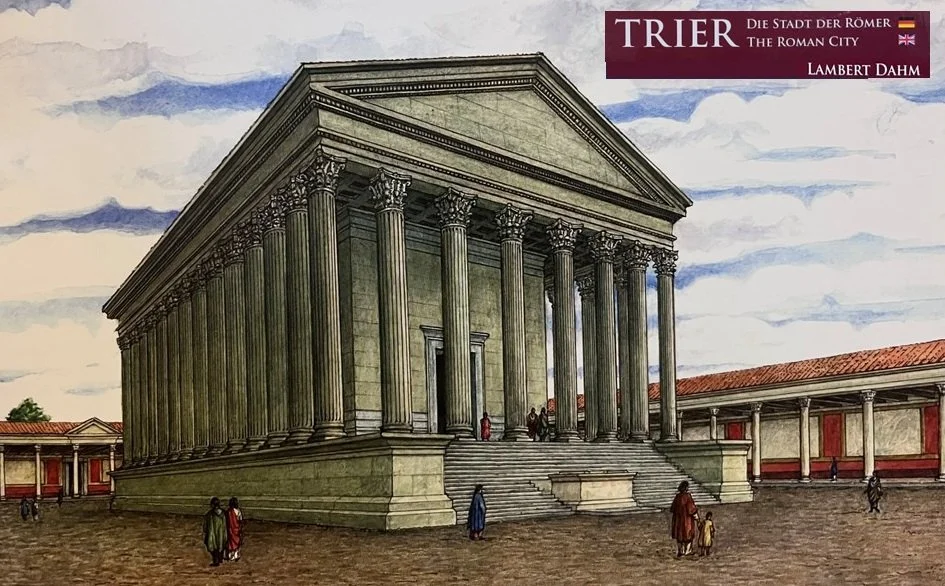
The so-called Temple of Asclepius, in Trier, is also known as the Temple on the banks of the Moselle. The lack of an agreed name reflects lingering uncertainty regarding its dedication.
During the construction of an underground parking garage on the grounds of the Borromean Sisters' Hospital in Trier in the 1970s, extensive sections of an ancient wall were uncovered, covering an area of 170 × 88 m. It thus spanned more than the width of a complete insula near the Moselle riverbank.
This would turn out to be part of large courtyard enclosed by porticoes. In the middle of this courtyard, a podium temple was unearthed, measuring 45 × 26 m, inside of which was the foundation of the cella (32.5 × 17 m) was exposed. It featured an apse or monumental niche on its northern narrow side, intended to house a statue of a divinity. Very little of the ancient temple remains to be seen today, since much of it was destroyed during construction of the parking garage. A portion of the rear wall of the temple has, however, been preserved and can be seen from inside the car park.
The archaeological findings long suggested that the temple was dedicated to the Greco-Roman healing god Asclepius. In the 18th century, a marble figure of Asclepius was discovered nearby (now lost), along with an inscription to Asclepius, today housed in the Rheinisches Landesmuseum in Trier. The insciption refers to the dedication of an image by Titus Saturninus, financial procurator residing in Trier in the late second century CE. Based on archaeological finds, the construction of the temple itself could be dated to the last third of the first century CE.
The design of the temple grounds, with its large porticoed courtyard, along with its proximity to the Forum has, however, raised the suspicion among historians that the finds linked to Asclepius could well be unrelated to the temple, and that this was in fact Trier’s Capitol. Following the example of Rome, all major Roman cities should have a temple dedicated to the Capitoline Triad: Jupiter, Juno, and Minerva. These gods were the protectors of the Roman Empire, and their worship was a public, political act, reinforcing devotion to the Empire. Importantly, the porticoed courtyard of this very large temple matches well the template for a city Capitol. The porticoed courtyard would have served as a bustling, sacred, and political space, a focal point for Roman state religion.
A 12th-century description of Trier's Roman remains does mention that the Capitol had been close to the Roman Bridge, which fits well this location, while no similar temple area has been found around the Forum.