
Romans on the Moselle
Basilica of Constantine
(aka Aula Palatina)
Literature:
Goethert, K-P. (2010) “Basilika”, in Römerbauten in Trier (2nd ed.). Führungsheft 20, Schnell & Steiner
Cüppers, H. (1990) “Trier - Die Palastbasilika”, in Cüppers (ed.) Die Römer in Rheinland-Pfalz
The Basilica of Trier, DKV ART GUIDE No. 620, Second edition 2013, Deutscher Kunstverlag GmbH, Berlin, Munchen.
Kiessel, M. (2011) “Die Architektur des spätantiken Palastareals nordöstlich und östlich der spätantiken Aula in Trier”, in Drauschke, J., Prien, R. and Ristow, S. (eds.), Untergang und Neuanfang, Schriftenreihe Studien zu Spätantike und Frühmittelalter, Band 3.
D’Onza, M.C. and Breitner, G. (2017) “Die Neupräsentation des Grabungsareals unter der Basilika in Trier”, in Funde und Ausgrabungen im Bezirk Trier : Aus der Arbeit des Rheinischen Landesmuseums Trier, Band 49.
Zahn, E. (1991) Die Basilika in Trier, Rheinisches Landesmuseum, Trier.
Useful web sites:
https://en.wikipedia.org/wiki/Aula_Palatina
https://de.wikipedia.org/wiki/Konstantinbasilika
https://www.trier-info.de/en/places-of-interest/the-basilica
Google map link:
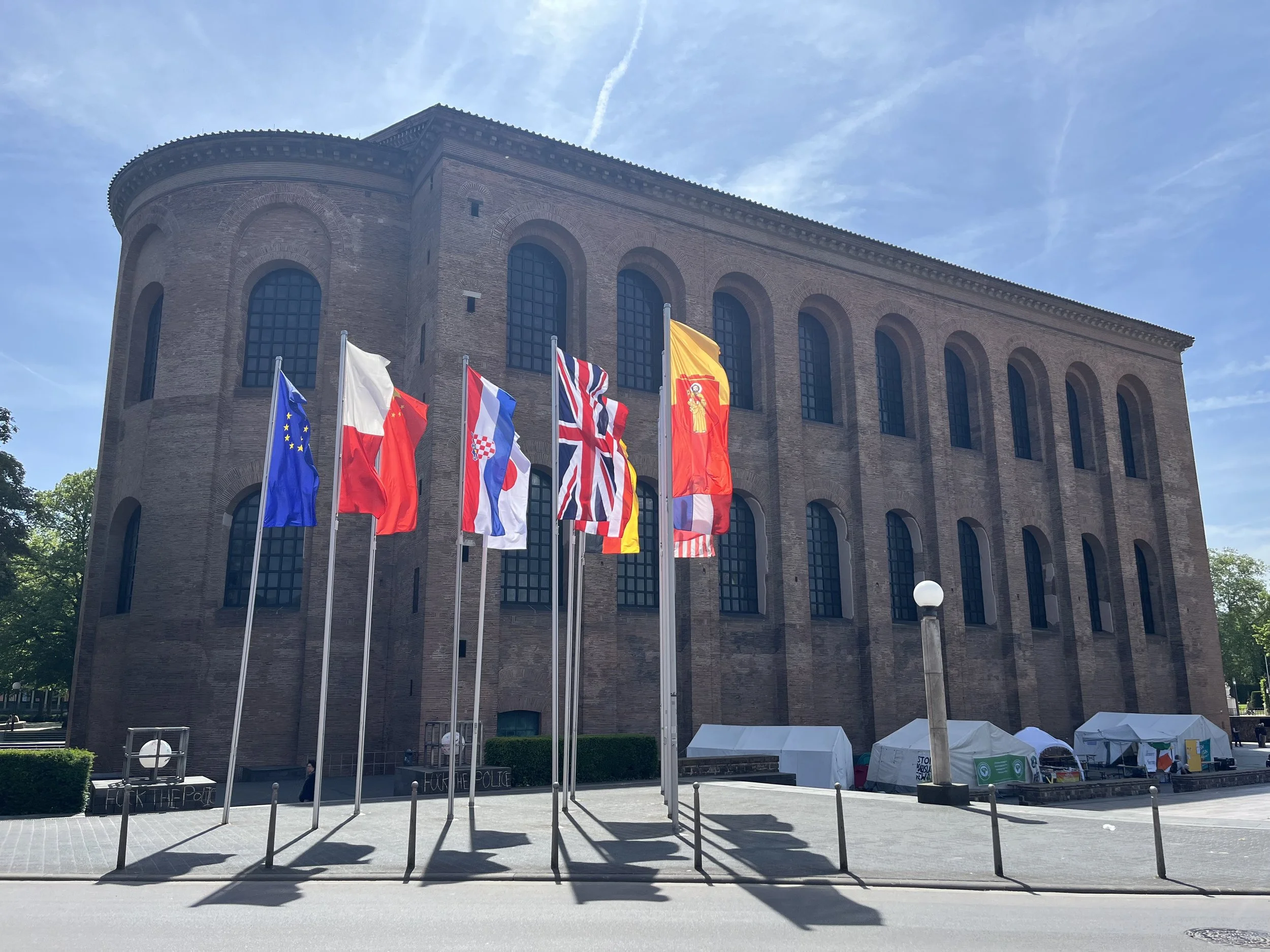
The Basilica of Constantine, also known as the Aula Palatina, was built in the early fourth century CE not as a church, but as the Emperor’s audience hall. Built to impress, it served as the centre of Roman imperial administration and the main venue for prestigious functions at a time when Trier was for a while the seat of the Roman Emperor himself. While only the Basilica itself remains in place today, in the fourth century it stood as the central structure in a larger palace district that also included two smaller halls, situated on each side of the Basilica.
The Basilica has been destroyed and rebuilt on several occasions since antiquity. It served as a Frankish estate in the early middle ages, before being converted into the residence of the Bishop of Trier in the 10th century. In the middle ages its window openings were for a while walled up, and the structure became a fortified castle in the heart of the city. Several other major modifications were undertaken in the late middle ages and the modern era. In the 19th century, Frederick William IV of Prussia ordered the building to be restored to its original Roman state. Following severe damage suffered during World War II, the Basilica was again restored, to its current form. Today the Basilica serves as a protestant church.