
Romans on the Moselle
Circus (Trier)
Literature:
Cüppers, H. (1990), “Der Circus”, Heinz Cüppers (ed.): Die Römer in Rheinland-Pfalz, pp. 599-600.
von Massow, W. (1949) “Der Circus des römischen Trier”, in Trierer Zeitschrift : für Geschichte und Kunst des Trierer Landes und seiner Nachbargebiete, Bd. 18.
Useful web sites:
https://www.livius.org/articles/place/augusta-treverorum-trier/trier-photos/trier-circus/
https://de.wikipedia.org/wiki/Augusta_Treverorum
https://trier-erleben.de/der-sieger-und-sein-draengler/
https://www.hotel-roemerbruecke-trier.de/trier-roemische-pferderennbahn.html
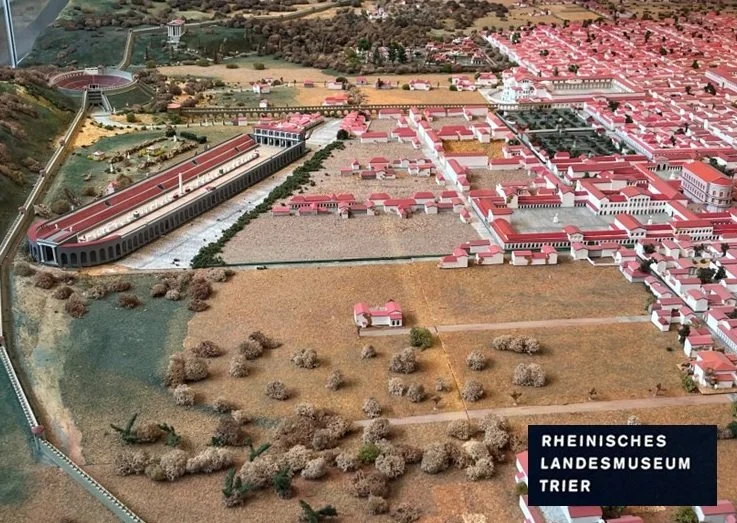
The Roman Circus of Trier has not survived and can only be surmised from the course of some streets below the amphitheater and Petrisberg. Its location is indicated by the distinct saddle formed by Egbertstrasse and Helenenstrasse, while the northern end was likely located at the present-day Agritiusstrasse. This would suggest a structure approximately 500 meters long.
Chariot races played a significant role in the self-representation of the Roman emperors, especially in Late Antiquity, and enjoyed immense popularity. The Polydus Mosaic from Trier, depicting a charioteer with his team, is a prominent example of how the circus was perceived. A relief of a charioteer also exists in the Neumagen funerary monuments. Since the Treveri are described in written sources as skilled horsemen, it can be assumed that horse racing remained a popular activity also in Roman times. While believed to have started off as a very simple race track in late first century CE, it was monumentalised to become an important element in the Imperial Palace district in the fourth century.
Following the Germanic invasions of the fifth century, the circus quickly fell into disuse and was soon destroyed. The stones were reused, and the area was taken over by agricultural activities. In the 19th century, the area south of Trier's main train station was developed with a residential area. The likely very limited surviving remains of the circus were not investigated at the time.