
Romans on the Moselle
Forum (Trier)
Literature:
Rheinisches Landesmuseum Trier/Landesmuseum Württemberg (2014) Stadtleben im römischen Deutschland - Offizieller Begleitband zur Ausstellung „Ein Traum von Rom“.
Cüppers, H. (1983) “Plan des Forums der Stadt Trier”, in Die Römer an Mosel und Saar, p290, Verlag Philipp von Zabern, Mainz.
Cüppers, H. (ed.) (1990) Die Römer in Rheinland-Pfalz, (pp. 577-584), Konrad Theiss Verlag GmbH & Co., Stuttgart.
Cüppers, H. (1979) “Das römische Forum der Colonia Augusta Treverorum”, in Festschrift 100 Jahre Rheinisches Landesmuseum Trier, pp. 211-262.
Useful web sites:
https://www.livius.org/articles/place/augusta-treverorum-trier/trier-photos/trier-forum/
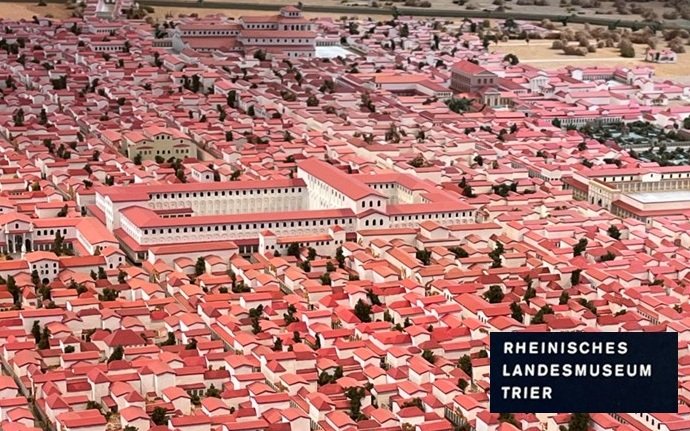
Like Rome itself, and any major Roman city, Trier needed a Forum; the center of Roman urban life and a place where the sanctuaries and institutions of urban self-government would be concentrated.
The Forum was the centre of a wide range of commercial, political and even religious activities. The events at the Forum would typically combine religious observance with social activities, feasting, and celebration, highlighting the integrated nature of religion in Roman public life.
Trier’s Forum was built in the first century CE, but further expanded and renovated on several occasions throughout the Roman period. As per Roman norm, the Forum was located in the centre of the city, at the intersection of the two main streets; the Cardo Maximus (which ran North-South) and the Decumanus (which ran East-West). These main streets connected directly with the four city gates, which meant that visitors would end up at the Forum by simply walking straight ahead from any city gate.
The Forum was a large complex, covering six city blocks (insulae). While little remains today, it stretched along the northern side of Kaiserstraße from today's Gerty-Spies-Straße in the West to Weberbachstraße in the East. It consisted of three plazas, enclosed by porticoes and rows of shops, covering a total area of 135 x 275 meters. In these large open spaces, Trier residents would gather to trade, debate and hear public announcements.
In-between these plazas was a large market basilica (located in the area of today's Neustraße). At 100 x 25 meters it was the largest Roman building in Trier in the 4th century. Remnants of its side walls can still be found today in the late medieval cellars of Neustraße. Surrounding the Forum there were many covered shops, making it the city’s main commercial area for a wide range of daily goods.
Extensive construction work was also carried out at the forum as part of the urban development of late antiquity. The tabernae were replaced by multi-story colonnades, and the market basilica was enlarged. The building plans from the Tetrarchic period remained unfinished. Architectural decoration from the second half of the 4th century suggests completion during the last golden age of Trier as an imperial residence.