
Romans on the Moselle
Forum Baths (aka Baths by the cattle market)
Literature:
Goethert, K-P. (2010) “Thermen am Viehmarkt”, in Römerbauten in Trier (2nd ed.). Führungsheft 20, Schnell & Steiner
Cüppers, H. (1990) “Trier - Thermenanlage am Viehmarkt”, in Cüppers (ed.) Die Römer in Rheinland-Pfalz
Faust, S. (2008) “Viehmarkt: Römische Thermen”, in Führer zu archäologischen Denkmälern des Trierer Landes, (p74) Schriftenreihe des Rheinischen Landesmuseums Trier 35.
Useful web sites:
https://www.zentrum-der-antike.de/monumente/thermen-am-viehmarkt
https://de.wikipedia.org/wiki/Thermen_am_Viehmarkt
https://www.trier-info.de/en/places-of-interest/viehmarkt-square
https://en.wikipedia.org/wiki/Forum_Baths,_Trier
Google map link: https://maps.app.goo.gl/cMSMLqiWGfWQVPjQ6
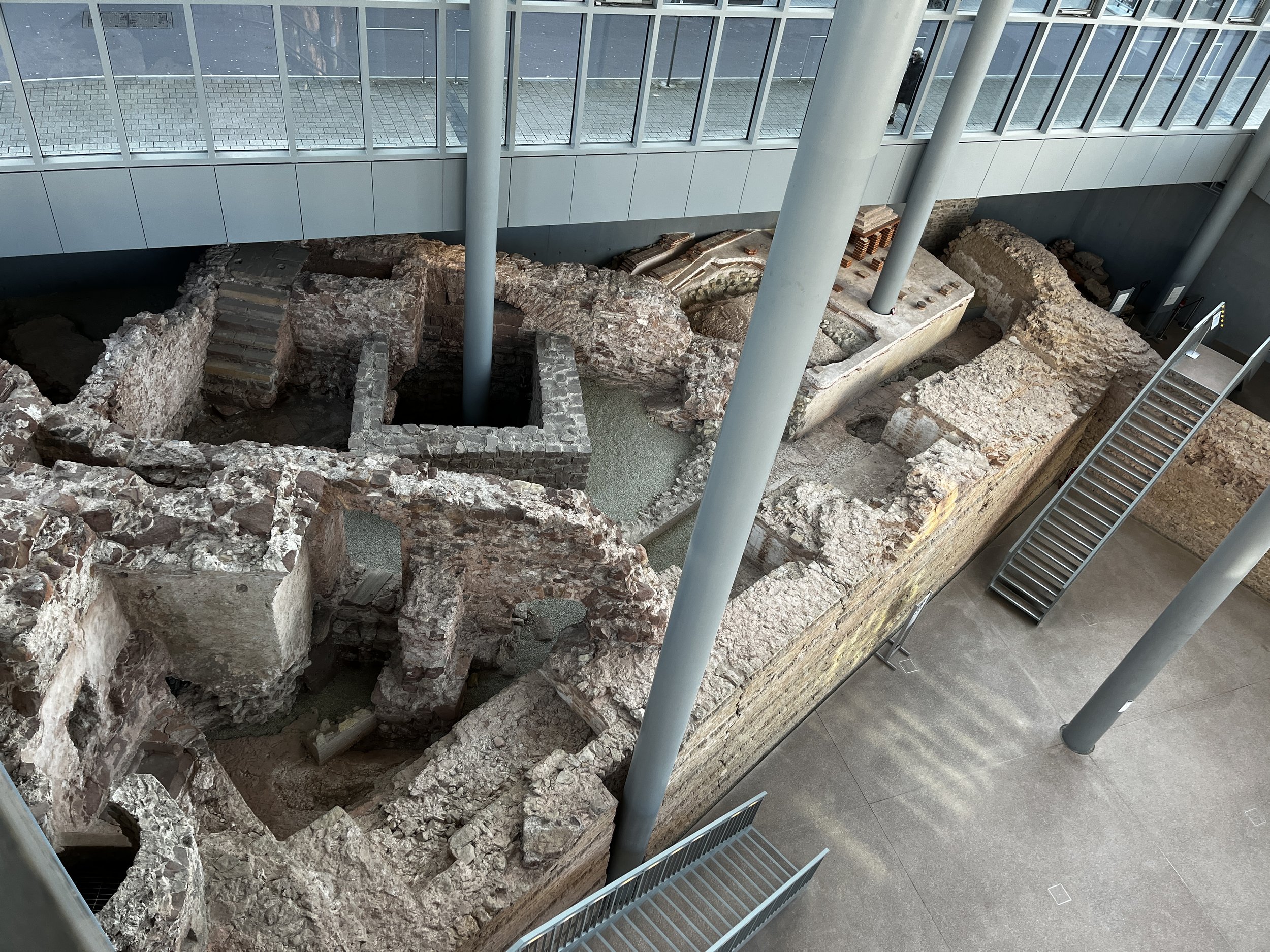
The Forum Baths (also referred to as the Baths by the Cattle Market after the location’s later function) are Trier’s oldest major thermal bath complex. It was built towards the end of the first century / early second century CE.
Its existence was largely unknown to historians until it was discovered in 1987 during excavations related to the construction of a parking garage.
Construction of the bath complex began around 80 CE, thus predating Trier’s other two Roman baths, the Barbara Baths and the Imperial Baths. The baths were designed so that the warm bath received light from the South, while the cold bath had its windows facing North.
The Forum baths, which were completed in the early second century, remained in use well into the fourth century, after which it fell into disrepair. In the 13th century, the ruins of the baths were used as a quarry.
In the 17th and 18th centuries, the Capuchin order erected a monestary at the site. After the dissolution of the monastery in 1802, its gardens were used as a cattle market. The ruins of the baths were forgotten, and it has been generally assumed that there were never more than two Roman thermal bath complexes in Trier (i.e. the Barbara Baths and the Imperial Baths).
The excavated baths and the remains of the monestary are today housed in a dedicated museum, a modern glass structure designed by the architect Oswald Mathias Ungers. The museum was opened to the public in 1998.