
Romans on the Moselle
Imperial Baths
Literature:
Goethert, K-P. (2010) “Kaiserthermen”, in Römerbauten in Trier (2nd ed.). Führungsheft 20, Schnell & Steiner
Cüppers, H. (1990), “Kaiserthermen”, Heinz Cüppers (ed.): Die Römer in Rheinland-Pfalz.
Faust, S. (2008) “Kaiserthermen”, in Führer zu archäologischen Denkmälern des Trierer Landes, (p50) Schriftenreihe des Rheinischen Landesmuseums Trier 35.
Dodt, M. (2017), “200 Jahre Ausgrabungen an den Trierer Kaiserthermen : Die Forschungen von Carl Friedrich Quednow und ihre Bedeutung”, in Funde und Ausgrabungen im Bezirk Trier: Aus der Arbeit des Rheinischen Landesmuseums Trier, Bd. 49.
Binsfeld, W. (2011), “Kaiserthermen - Zur Deutung der römischen Bäder in Trier”, Funde und Ausgrabungen im Bezirk Trier: Aus der Arbeit des Rheinischen Landesmuseums Trier, Bd. 43.
Useful web sites:
https://www.zentrum-der-antike.de/monumente/kaiserthermen
https://www.diessenbacher.com/projekte/zentrumderantike/
https://en.wikipedia.org/wiki/Trier_Imperial_Baths
https://de.wikipedia.org/wiki/Kaiserthermen_(Trier)
https://www.trier-info.de/sehenswuerdigkeiten/kaiserthermen
Google map link: https://maps.app.goo.gl/YJ4ETTnPu62c6CnQ8
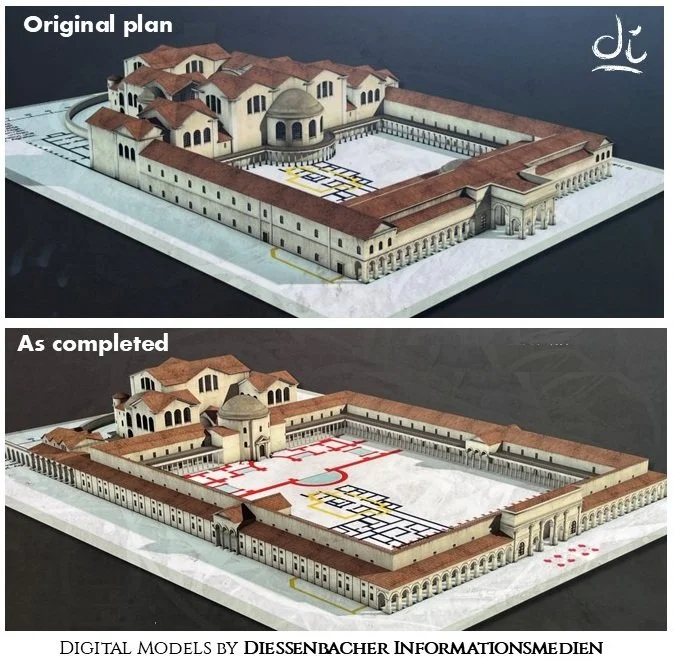
The Imperial Baths (Kaiserthermen) were Trier’s third major thermal bath complex, following the pre-existing Forum Baths and Barbara Baths. Construction on the ambitious Imperial Baths began in the early fourth century CE, but was interrupted before completion due to the ongoing Roman civil war at the time.
The unfinished structure of the Imperial Baths, whose western section likely never progressed beyond the foundations, remained unused for the following decades and began to decay. It was only during the reign of Emperor Gratian (375–383) – who, like his father Valentinian I before him, had once again chosen Trier as his capital – and after his assassination under his brother Valentinian II (375–392), that the building began to be repurposed as a garrison for the scholares, the mounted imperial bodyguard.
The enormous, free-standing hall of the planned frigidarium was demolished, and the underground structures in the western part of the building were filled in. What remained was the former caldarium with its three apses and some western structures, including two large rectangular rooms facing each other and the rotunda of the tepidarium between them, which now formed the entrance to the makeshift principia (headquarters building).
As was customary for a Roman garrison, a military bath was built to the west of the former caldarium. The soldiers were housed in standardized barracks (contubernia), most of which were constructed over the foundations of the planned palaestra (palace).
The resulting enclosed square was surrounded on all four sides by a portico. The eastern boundary of the barracks was formed by a massive defensive wall, which ran in a semicircle from the southern corner of the military bath around the caldarium, enclosing a space of over 20 meters.