
Romans on the Moselle
Temple of Lenus-Mars (Trier)
Literature:
Schwinden, L. (1983) “Heiligtum des Lenus Mars”, in Die Römer an Mosel und Saar, Verlag Philipp von Zabern, Mains, pp. 325-326.
Cüppers, H. (1990), “Tempel des Lenus Mars”, Heinz Cüppers (ed.): Die Römer in Rheinland-Pfalz, pp. 593-595.
Faust, S. (2008) “Irminenwingert: Tempelbezirk”, in Führer zu archäologischen Denkmälern des Trierer Landes, Schriftenreihe des Rheinischen Landesmuseums Trier 35.
Useful web sites:
https://de.wikipedia.org/wiki/Tempelbezirk_Irminenwingert
https://kulturerbe-eifel-mosel.de/weitere-monumente/lenus-mars-tempel
https://en.wikipedia.org/wiki/Lenus
Google map link: https://maps.app.goo.gl/uPYXCZvvAuU4M1MS9 (temple)
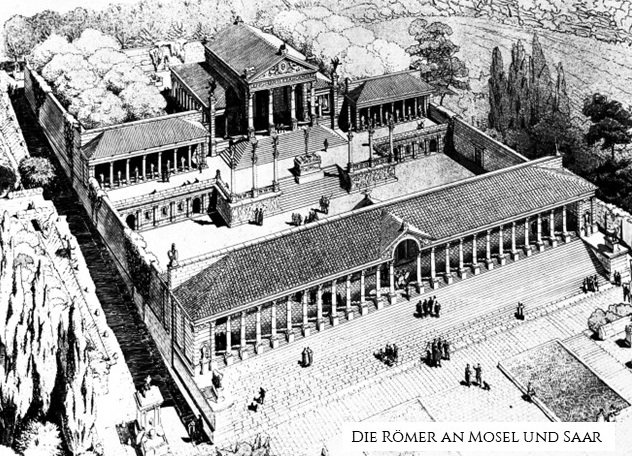
The Temple of Lenus Mars is located in Trier on the western side of the Moselle river, which in Roman times was outside the city walls. It was situated below a spring revered by the Treveri as having special healing powers.
On the hillside was a temple, accessible via a flight of steps and surrounded on three sides by a portico, thus exhibiting elements of a Gallo-Roman ambulatory temple. A larger altar foundation was discovered on an intermediate terrace. About 60 meters away, along the access and processional road in front of the temple, two inscribed benches made of red sandstone were found next to two votive altars. The inscriptions attest to a dedication to Lenus Mars. Lenus was the Celtic god of healing and protection in Battle, and could thus be easily associated with the Roman war god Mars. Lenus also played a significant role in other regional sanctuaries such as the Martberg.
The entire complex is considered a Treveran national sanctuary with monumental furnishings. The furnishings of the complex reflect the less warlike character of Lenus, who was more often venerated as a healing god. According to the coin series, the complex was used from pre-Roman times until the reign of Gratian in the late fourth century CE.
In the northeast of the complex, substantial wall sections with a richly articulated niche front can be identified as the stage front and outer wall of a theater. Theaters, as part of cult festivals and the performance of divine myths, were a frequent feature of sacred precincts.