Romans on the Moselle
Villa Bollendorf
Selected literature:
Cüppers, H. (ed.) (1990) Die Römer in Rheinland-Pfalz, Konrad Theiss Verlag GmbH & Co., Stuttgart, pp. 338-340.
Gilles, K-J. (2008) “Herrenhaus eines römischen Gutshofes”, in Faust, S. (et. al.) eds., Führer zu archäologischen Denkmälern des Trierer Landes, Schriftenreihe des Rheinischen Landesmuseums Trier 35. Rheinisches Landesmuseum Trier, pp. 90-91.
Heinen, H. (1985) 2000 Jahre Trier: Trier und das Trevererland in Römischer Zeit, Spee-Verlag, Trier. See chapter on Rural Estates on pp. 132-141.
Seiler, S. (2012) “Die Villa von Bollendorf: klein, aber fein”, in Rupp, V. and H. Birley, eds. (2012) Landleben im römischen Deutschland, Verlag WBG (Wissenschaftliche Buchgesellschaft), pp. 164-166.
Useful web sites:
https://de.wikipedia.org/wiki/Villa_rustica_(Bollendorf) (in German)
https://www.felsenland-suedeifel.de/pois/roemische-villa-bollendorf-1
http://archaeopro.de/Archaeopro/Strukturen/Bollendorf.htm
Google maps: Villa Bollendorf
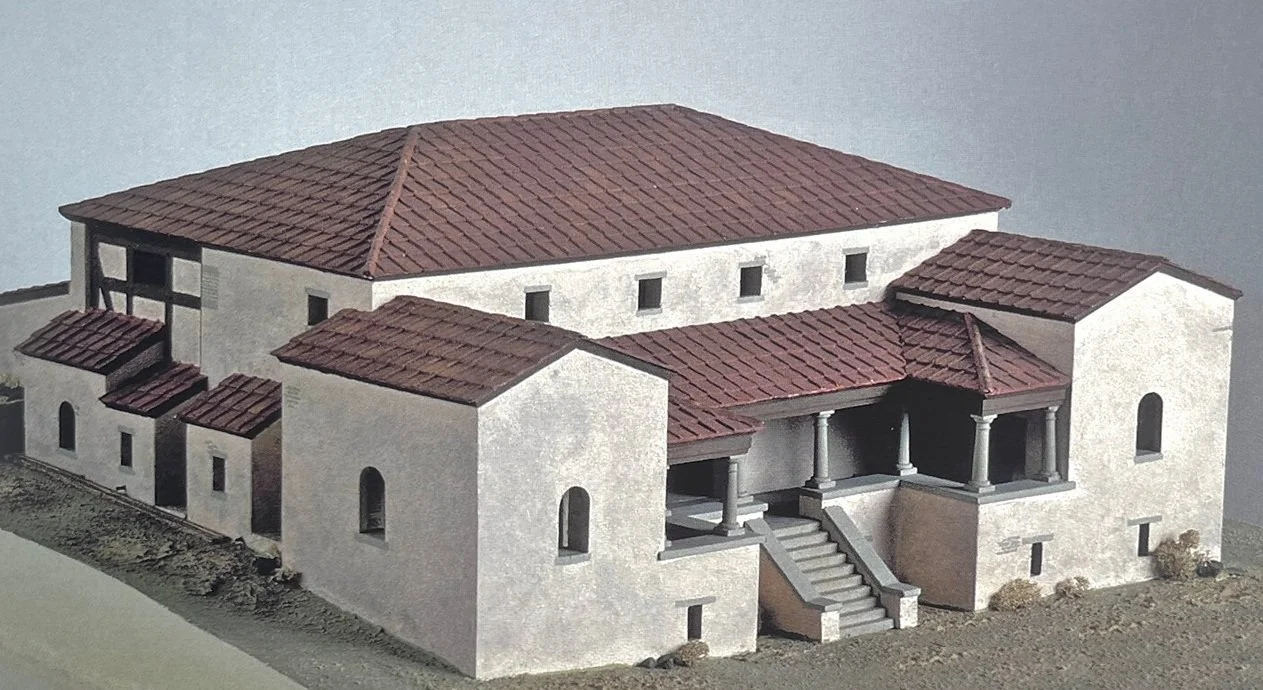
Villa Bollendorf is a relatively small Villa Rustica, measuring around 480 square meters (23.4m x 20.4m). It was built towards the end of the first century CE, extended to its final look in the third century, before ultimately succumbing to the Frankish invasions of the fifth century.
It is placed on a hillside overlooking the river Sauer, a tributary of the Moselle. A road connected it to the river, which was navigable in Roman times. This provided the means for transporting agricultural products to the market. In Roman times, this was just one of many agricultural estates in the fertile Sauer Valley region.
The villa consists of one larger central building, with two projecting “risalit” corner towers on each side, with a covered veranda and staircase in front, thus lending the exterior a monumental impression from the river valley below. Several other villas of this type have been found in the region, but it was much less common around the Mediterranean.
It was first discovered in 1895 and was thus one of the first villas in the region to be thoroughly excavated. The modern protective structure was erected in 1997, and this allowed for a partial reconstruction of some of the interiors.
An interior staircase led from the main hall into a food storage cellar located under the front portico. In the late 2nd century CE, a bath suite was added on the left side, which included a small changing room, a cold bath, a luke-wamp room and a hot bath, heated with hot air through a hypocaust system heated in the main hall.
The archaeological site is open to the public.