Romans on the Moselle
Villa Boos
Selected literature:
Cüppers, H. (ed.) (1990) Die Römer in Rheinland-Pfalz, Konrad Theiss Verlag GmbH & Co., Stuttgart, pp. 342-343.
Rupprecht, G. (2012) “Die villa rustica in Boos. Unter dem Schutz der Kirche”, in: Rupp, V. (ed.) Landleben im römischen Deutschland, Stuttgart, pp. 167-168.
(more literature references on the first web site below)
Selected web sites:
https://www.regionalgeschichte.net/naheland/boos/kulturdenkmaeler/die-villa-rustica-in-boos.html
https://en.wikipedia.org/wiki/Boos,_Bad_Kreuznach
https://klessing-hoffschildt-architects.com/germany-boos-roman-villa-conservation-and-presentation/
Google map link: Villa Boos
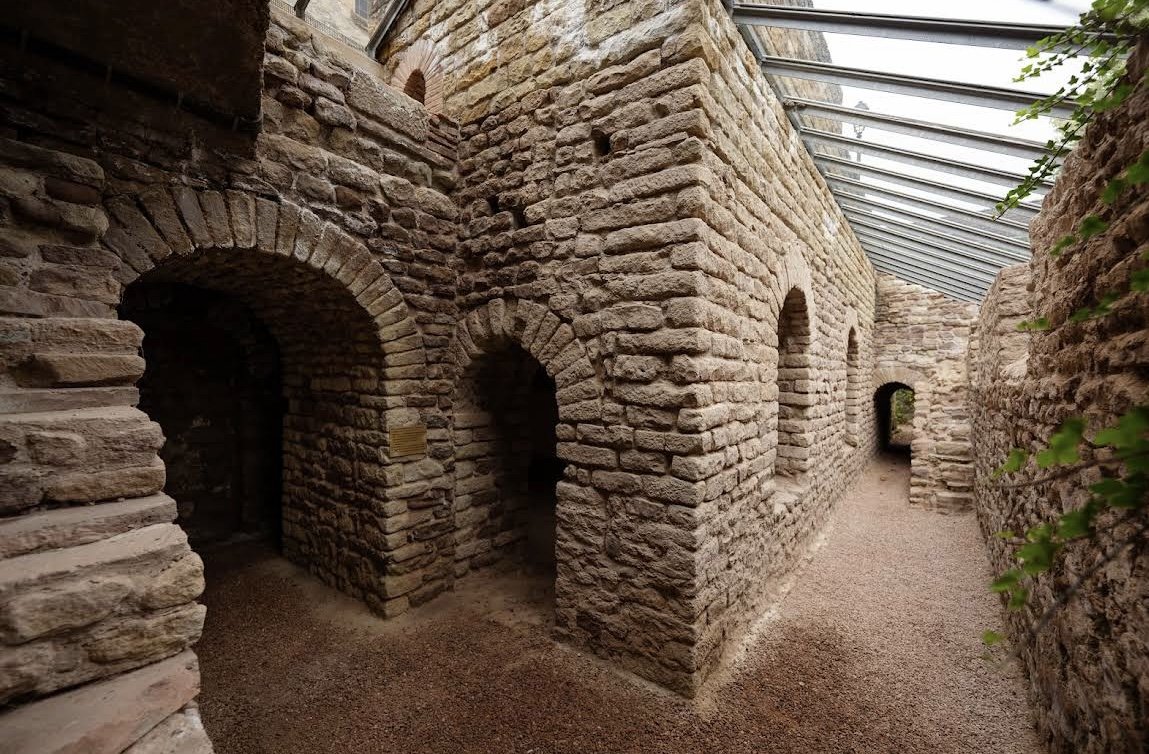
Villa Boos is a Roman villa rustica whose surviving cellar has survived hidden underneath the village’s protestant church. Its apse, built in 1966, rests on the Roman foundations.
The original villa stretched far beyond the church itself. Some of its remains were first discovered and partially excavated in the 1920s, but the lack of funds meant that it was not properly investigated and documented until the 1980s. The uncovered cellar was made accessible to the public in the early 1990s. It is normally open to the public on weekends.
The cellar, known as a cryptoporticus, consisted of several rooms connected to the rest of the house with two staircases. Each room has a large window opening on its south side, allowing daylight to illuminate the rooms.
Due to its underground location, temperatures nevertheless remained low, making the basement ideal for storage. The preserved ceiling also shows traces of the underfloor heating system from the residential floor above.
Beyond this relatively small cellar space, much of the rest of the villa remains unexcavated and hidden underneath the current buildings of the village. Presumably the main entrance was to the South, while the main building of the villa rustica extended over an area of approximately 20 x 18 meters to the North and east. Despite the lack of documentation from the earlier excavation, the villa's period of use is believed to be dated to the second and third centuries CE.
Although the outbuildings that would certainly have been present at the villa rustica have not yet been uncovered, remains of its cemetery have been, located 100m northwest of the manor house.