Romans on the Moselle
Villa Echternach
Selected literature:
Metzler, J., Zimmer, J. and L. Bakker (1983) “Die römische Villa von Echternach (Luxemburg) und die Anfänge der mittelalterlichen Grundherrschaft”, in Beihefte der Francia, Vol. 11, pp. 30-45.
Article in Luxembourger Wort (2024): https://www.wort.lu/kultur/villa-bei-echternach-mit-dem-zeichenstift-zurueck-in-die-roemer-zeit/23662415.html
Krier, J. (2016) “Eine seltene Terrakotte aus der römischen Villa in Echternach”, in Archaeologia Luxemburgensis 3, pp. 64-75.
Seiler, S. (2015) “Repräsentation und otium in römischen Villen des Trierer Landes”, in Archäologentage Otzenhausen 2, Archäologie in der Großregion, pp. 149-165.
Selected web sites:
https://www.mnaha.lu/en/roman-villa-echternach
https://www.nationalmusee.lu/en/publications/museoblog/a-new-season-at-the-roman-villa
https://www.visitechternach.lu/en/plug/museum/gallo-roman-villaof-echternach
https://www.visitluxembourg.com/place/gallo-roman-site-echternach
Google map link: Villa Echternach
The palatial villa at Echternach is located on the river Sauer, a tributary to the Moselle. Unlike some other, more modest Villae Rusticae in the region at the time, the one at Echternach quickly became a very large, luxurious palatial villa, with marble-clad walls, mosaic floors, thermal baths and underfloor heating.
First built in 70 CE, this palatial residence was one of the most luxurious villas in the region.
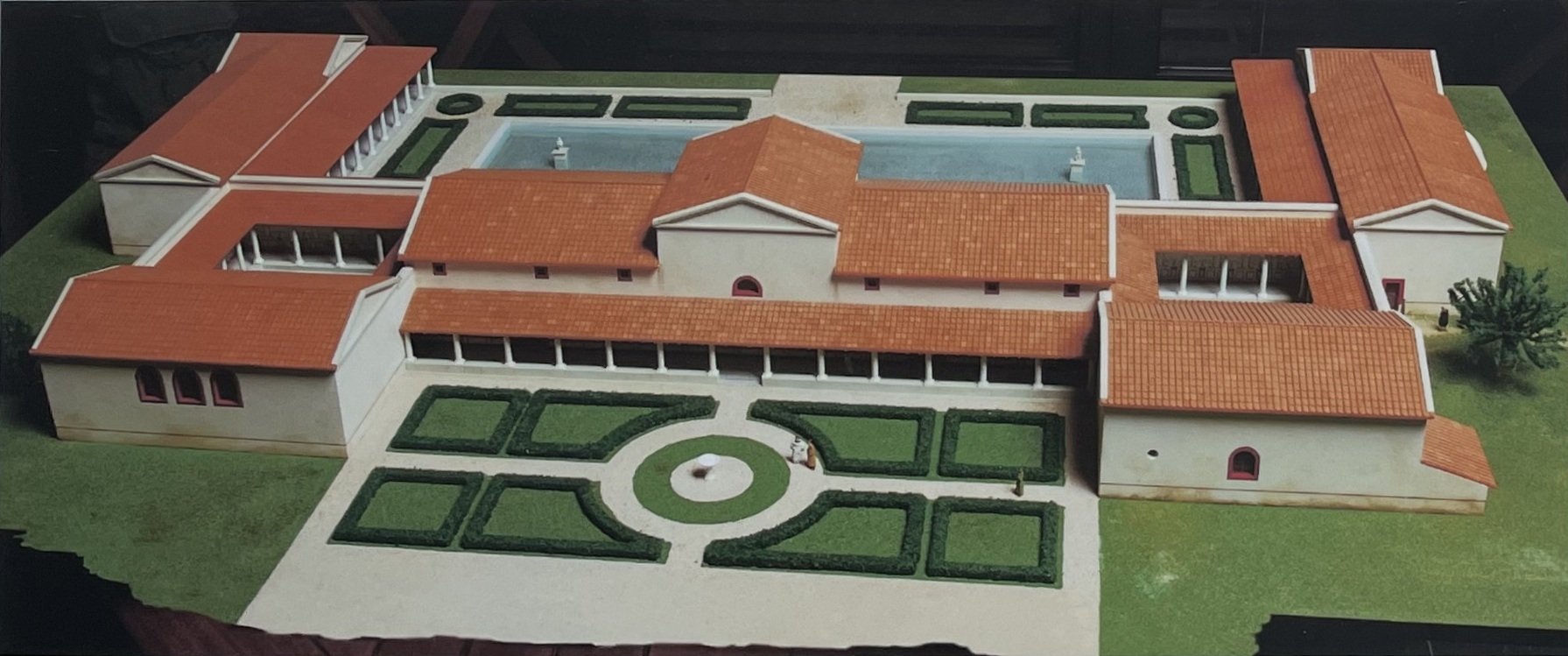
The large manor house was excavated in the mid-1970s and its foundations are now accessible to visitors. The visitor centre provides a wealth of information and has an exquisite miniature model of the villa.
In its basic design, the Echternach villa adheres to the region’s common design of a large main building flanked by two projecting corner buildings, with a porticoed front terrace in between. The size, however, is notably larger, measuring 118 x 62 meters. It quickly reached its full extent of almost 1 hectare, initially comprising around 40, and later up to 80, rooms.
A unique feature of this villa is its 59 x 14.5 meter ornamental pond in front of the main façade, accompanied by its over 160 meter long portico.
Aerial archaeology at the time of excavation revealed a walled farmyard of over 5 hectares that extended in front of the front of the main building. This included at least ten symmetrically arranged outbuildings, which would include servants' quarters, granaries, barns, sheds, stables, and workshops. This shows that the villa complex was the centre of a large agricultural estate.
Today you can stroll past the villa’s well-preserved walls into its Roman garden, complete with medicinal plants, vegetables, herbs and spices as well as a vine-covered pergola and fruit trees.