Romans on the Moselle
Villa Mehring
Selected literature:
Rupp, V. and H. Birley (2012) “Mehring: villa rustica mit 34 Räumen”, in Rupp V. and H. Birley, eds., Landleben im römischen Deutschland, Verlag WBG (Wissenschaftliche Buchgesellschaft), pp. 162-163.
Cüppers, H. (ed.) (1990) Die Römer in Rheinland-Pfalz, Konrad Theiss Verlag GmbH & Co., Stuttgart, pp. 477-478.
Selected web sites:
https://de.wikipedia.org/wiki/Villa_Rustica_(Mehring) (In German)
https://en.visitmosel.de/cities-culture/poi/roman-villa-1
https://www.outdooractive.com/en/poi/moseltal/roman-villa/54949284/
https://www.roemer-tour.de/roemerspuren/deutschland/rheinland-pfalz/villa-rustica-mehring/
https://www.strassen-der-roemer.eu/stationen/roemische-villa-rustica-mehring/
Google map link: Villa Mehring
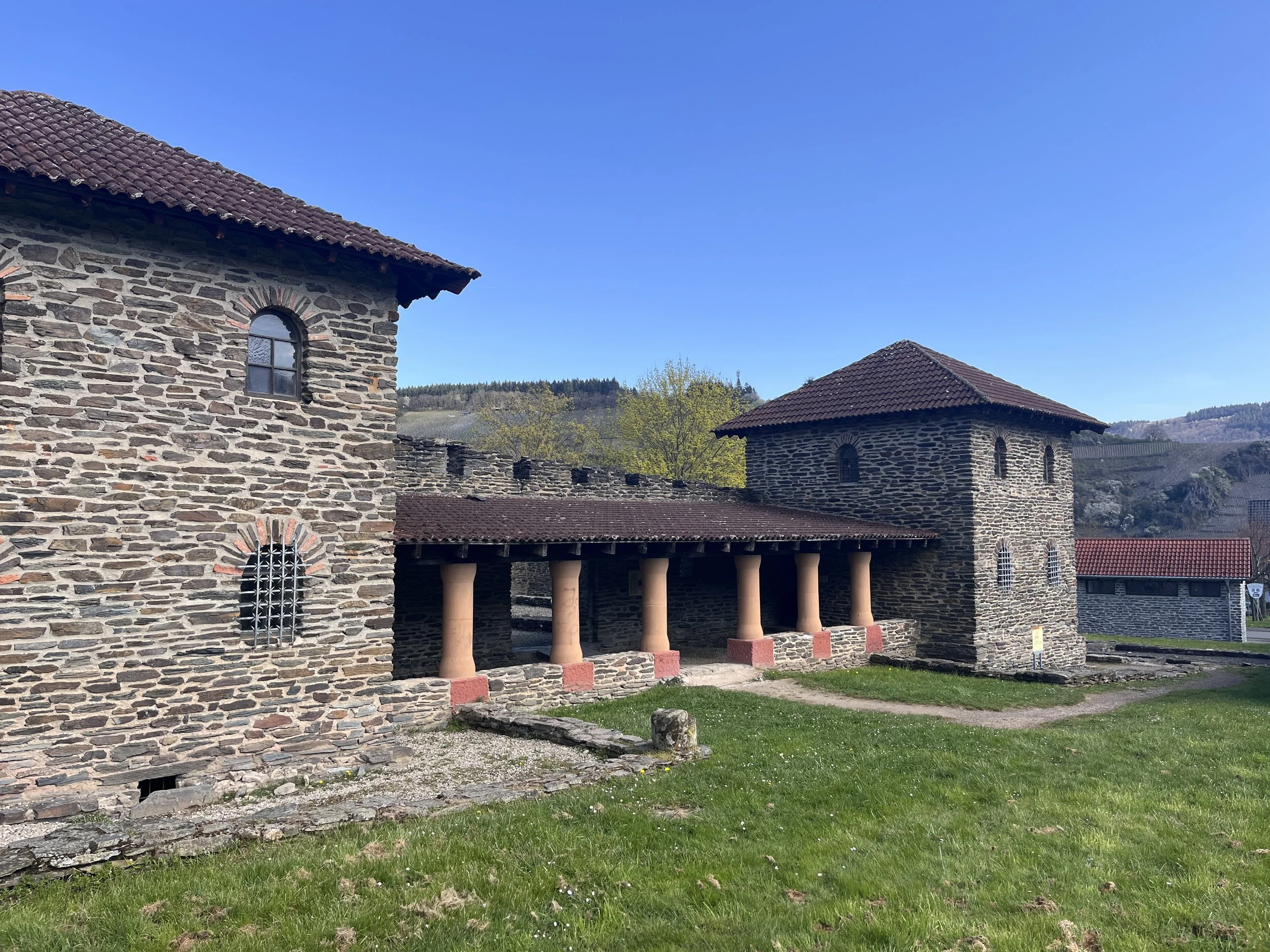
Villa Mehring is a large Roman villa rustica located East of Trier. Built in the mid-second century CE, it started off as a moderately sized villa similar to that in Bollendorf. It consisted of one large central building, with two projecting corner towers in front, and a columned portico in-between.
It was well placed, close to an important road and with a beautiful view of the Moselle river valley. A bathing complex with hot and cold baths and a latrine was added towards the end of the second century. As the Romanised owners gradually grew more prosperous, they extended the villa substantially in the third and early fourth centuries. At its peak, with 34 rooms, it was one of the larger rural villas in the Trier region. Archaeological finds attest to the owners’ privileged position, including the baths, the villa’s heated, mosaic-decorated living room, fragments of gold glassware and a small silver spoon.
The villa at Mehring included — similar to many other country villas — a cellar, which served as a storeroom for perishable foodstuffs and wine. It was located beneath one of the corner projections.
The villa was destroyed by Germanic invaders in the mid-fourth century. The ruins of the villa remained visible in the landscape and thorough excavation and partial reconstruction were undertaken in the 1980s.