Romans on the Moselle
Villa Nennig
Selected literature:
Echt, R. (2003) “Die römische Villa von Nennig: neue Ausgrabungen, neue Einsichten”, in Saarbrücker Studien und Materialien zur Altertumskunde, Vol. 9, pp. 137–178.
Echt, R. (2016) “Endlich entdeckt: Das Drum und Dran der Landwirtschaftlichen Anwesen - Das neue Bild der Villa von Nennig, Kr. Merzig-Wadern (Saarland)”, in R. Echt, B. Birkenhagen and F. Sărăţeanu-Müller, eds., Monumente der Macht: Die gallo-römischen Großvillen vom längsaxialen Typ, Saarbrücker Beiträge zur Altertumskunde, Vol. 90, pp. 303-323.
Selected web sites:
https://www.roemischevillanennig.de/de/
https://de.wikipedia.org/wiki/R%C3%B6mische_Villa_in_Nennig
https://www.saarschleifenland.de/en/poi/detail/roman-villa-nennig-92613f32ab
http://www.archaeopro.de/archaeopro/WEB-2013/Rekonstruktion/V-Nennig-1/Villa%20Nennig_1.htm
Google map link: Villa Nennig
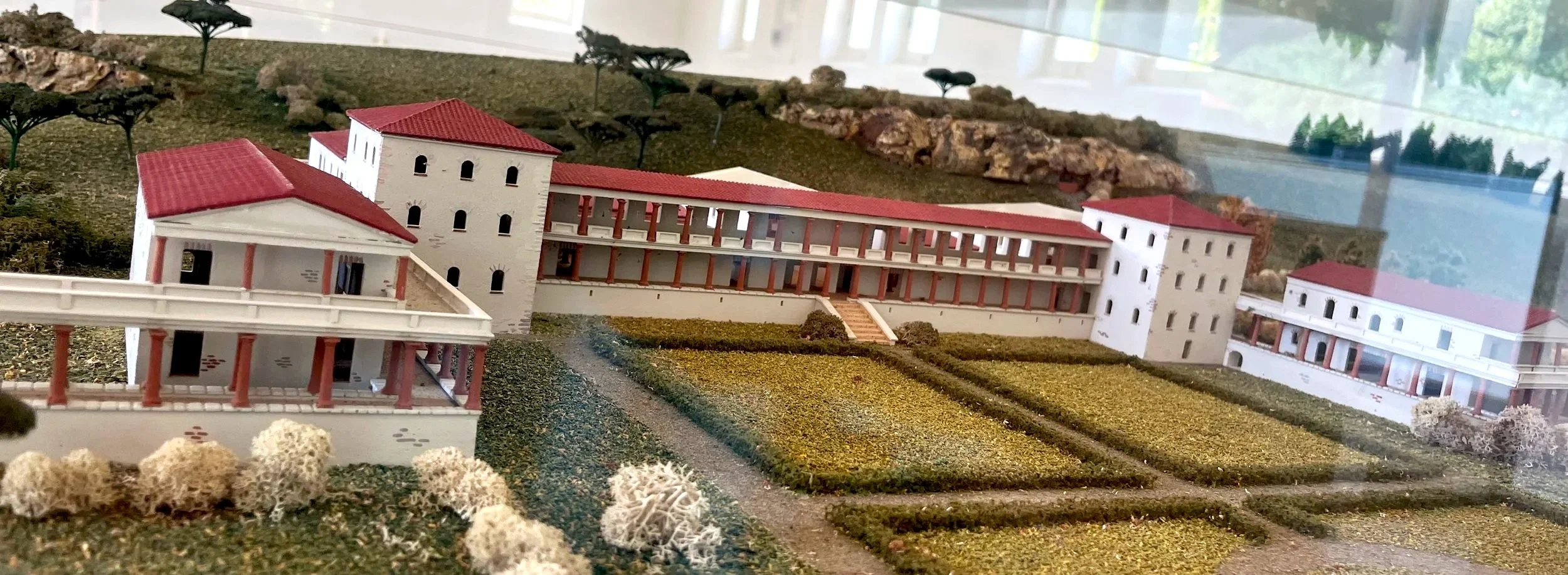
The palatial villa at Nennig is best described not as a villa rustica, but rather a “villa urbana”, with its emphasis on extreme monumentalism and luxurious decorations inside and out. From the river valley below, the view of the villa is dominated by its 256 meter long, free-standing portico in front of the main building. Although the basic design follows the template of other villas in the region, with two projecting corner towers with a portico in-between, the scale is here notably larger.
With the main building at the centre, the portico extends on the right side towards the family’s burial site (tumulus) closer to the river.
The villa’s magnificent floor mosaic was discovered by a farmer in 1852 and excavated along with the palace from 1866 to 1876. Restoration work on the mosaic was completed in 1874, notably with the help of the Villeroy & Boch ceramics factory in nearby Mettlach, which established a mosaic tile factory specifically for this purpose. Following damages caused by the war, the mosaic was again restored in the 1960s.
The mosaic was located in the villa’s large representative entrance hall. Composed of around three million pieces, it shows scenes from a spectacle in the amphitheater.
It is made accessible for the general public in its dedicated modern museum building.