Romans on the Moselle
Villas and agriculture
Selected literature:
Ferdière, A. (2020) “Agriculture in Roman Gaul”, in Hollander, D. and T. Howe, eds. (2020) A Companion to Ancient Agriculture, Wiley Blackwell.
Heimberg, U. (2012) Villa rustica. Leben und Arbeiten auf römischen Landgütern, Verlag WBG (Wissenschaftliche Buchgesellschaft).
Reddé M. (2017) “Native Farms and Roman Villae in “Long-haired” Gaul: A Confrontation between Classical Sources and Archaeological Data”. Annales Histoire, Sciences Sociales, 72(1): pp. 41-68.
Roymans, N. and T. Derks (2011) Villa Landscapes in the Roman North: Economy, Culture and Lifestyles, Amsterdam Archaeological Studies, Amsterdam University Press.
Rupp, V. and H. Birley, eds. (2012) Landleben im römischen Deutschland, Verlag WBG (Wissenschaftliche Buchgesellschaft).
Heinen, H. (1985) 2000 Jahre Trier: Trier und das Trevererland in Römischer Zeit, Spee-Verlag, Trier. See chapter on Rural Estates on pp. 132-141.
Useful web sites:
https://en.wikipedia.org/wiki/Villa_rustica
https://de.wikipedia.org/wiki/Villa_rustica (In German, but a bit more detailed).
https://en.wikipedia.org/wiki/Agriculture_in_ancient_Rome
Selected Gallo-Roman villas in the Moselle region:
Villa Bollendorf
Villa Boos
Villa Borg
Villa Echternach
Villa Longuish
Villa Mehring
Villa Nennig
Villa Otrang
Villa Wittlich
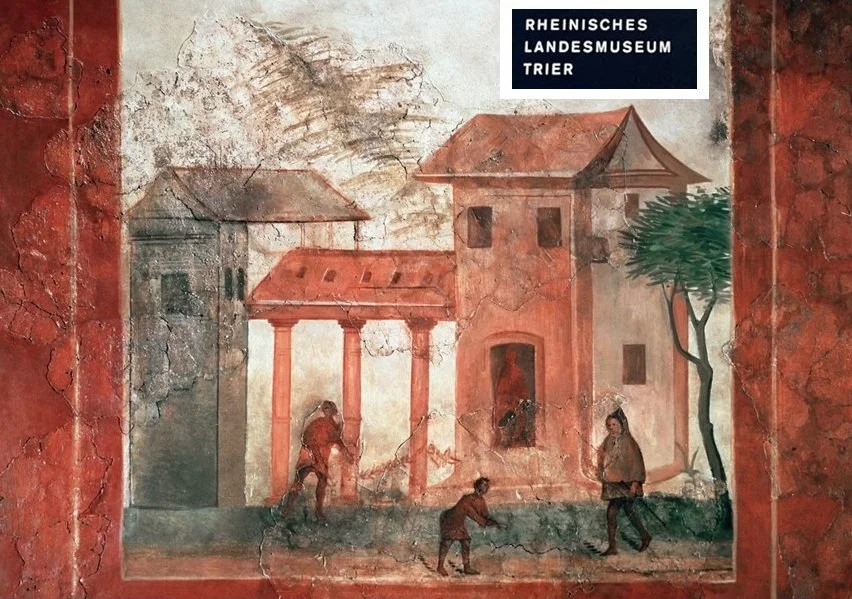
As we discuss in Episode 6 of “Romans on the Moselle”, the arrival of the Romans to the land of the Treveri fostered the further development of their agricultural economy. The first catalyst for this was a boost to demand, initially by the Roman Army and later on by the growing city of Trier. The second catalyst was to make available new farming techniques and technologies. Since the Romans both collected taxes and paid for farm products in cash, they contributed to the further monetisation of the economy, increasing its efficiency. The Treveri landowners expanded their cultivated farmlands, hired more farm workers and specialised craftsmen with skills to manufacture and maintain tools and equipment. The resulting financial surplus allowed the landowners, even after paying their taxes, to invest in country estates that became increasingly elaborate over time.